Speed without coherence doesn't scale.
Agile optimised for movement.
AI optimises for acceleration.
ARC exists to make systems move in the same direction.
What is ARC
ARC is a methodology for reasoning about software systems as they grow. It doesn't prescribe process, roles, or tools. It names a problem that keeps reappearing: systems that move fast locally while fragmenting globally.
In modern teams, architectural decisions are often implicit. They live in code, habits, and individual intuition. AI accelerates delivery, but also amplifies those implicit decisions, good or bad.
ARC exists to make architectural intent explicit before speed turns into chaos.
What ARC is not
ARC is not a replacement for Agile.
It is not a delivery framework.
It is not a productivity system.
ARC is a way to think about coherence before, during, and after implementation.
The Framework
ARC is a recursive pattern.
It operates at every scale: a function, a service, a subsystem, an organisation.
The same questions repeat:
Do we understand what we are building?
Are we reinforcing patterns or creating exceptions?
Are we consolidating learning or letting drift accumulate?
Align
Define architecture before code
Explicit architectural decisions. Shared understanding. Pattern identification.
Realize
Pattern + feature together
Implement with intention. AI-assisted with guardrails. Coherent execution.
Consolidate
Validate and propagate
Verify coherence. Extract patterns. Prevent drift. Systemic integrity.
Fractal Nature
ARC does not happen once. It happens continuously, at different levels of the system, whenever decisions are made. The same cycle applies to a single function and to an entire platform.Scale changes. The questions remain.
Cognition & Systems
Software systems reflect how people think. Some engineers reason linearly. Others reason in patterns. Most teams contain both.
ARC doesn't optimise for a thinking style. It makes architectural intent explicit so different cognitive approaches can coexist without fragmenting the system.
When architecture remains implicit, diversity of thinking becomes technical debt.
AI & Architecture
AI does not introduce chaos.
It reveals it.
When architectural intent is explicit, AI reinforces coherence. When intent is implicit, AI multiplies inconsistency at scale.
ARC treats AI as an amplifier, not a solution. The patterns you feed it determine the patterns it produces. Without explicit architecture, AI becomes a chaos accelerator.
The question is not whether to use AI. The question is whether your architecture can survive being amplified.
ARC & Agile
| Aspect | Agile | ARC |
|---|---|---|
| Focus | Velocity & iteration | Coherence & patterns |
| Architecture | Emergent (often implicit) | Explicit & intentional |
| Decisions | Team autonomous | Team aligned on patterns |
| AI Integration | Tool for speed | Tool with guardrails |
| Technical Debt | Managed later | Prevented by design |
ARC does not compete with Agile.
Agile answers “how do we move?”
ARC answers “are we still moving together?”
The Book
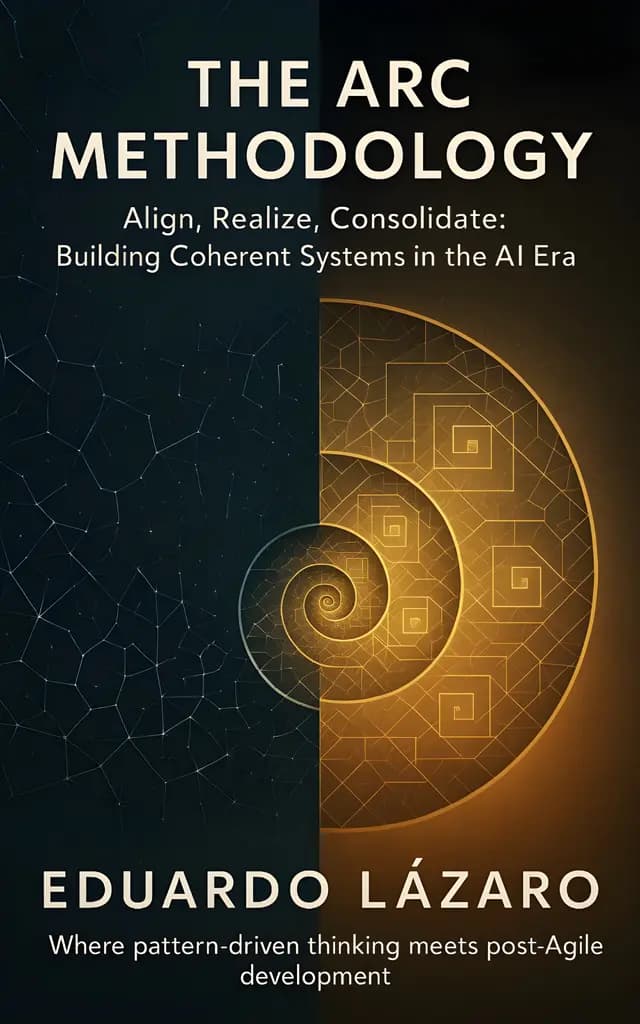
The ARC Methodology is documented in a book of the same name. The book expands the framework, provides examples, and explores how ARC applies across teams and organisations.
Reading the book is not required to understand ARC, but it provides depth and context.
Origin
ARC emerged from practice. Not as a product, but as a name for a pattern that kept repeating.
After years of working in and leading engineering teams, certain patterns kept appearing across the industry: systems that start clean but drift into chaos. Speed was the goal, but coherence was the casualty.